Clash! 8 Cultural conflicts that make us who we are by Hazel Rose Markus Ph.D. & Ph.D. Alana Conner
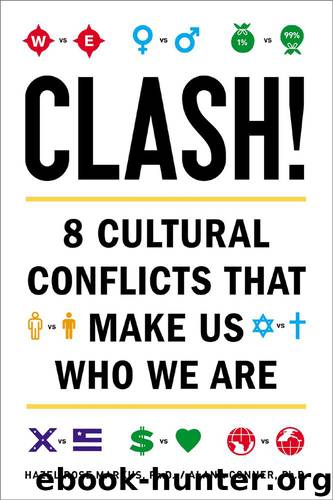
Author:Hazel Rose Markus, Ph.D., & Ph.D. Alana Conner [Alana Conner, Ph.D.]
Language: eng
Format: mobi
ISBN: 9781101623602
Publisher: Hudson Street Press
Published: 2013-05-01T18:30:00+00:00
By the Book or per the Pope?
Examining the different practices, artifacts, and institutions of Catholics and Protestants has been the pastime of many social scientists. Plotting these findings reveals several forces that have maintained and reflected an independent self among Protestants and an interdependent self among Catholics.
Perhaps the most famous work on the ways of Protestants was Max Weber’s The Protestant Work Ethic and the Spirit of Capitalism. Weber’s jumping-off point was a slightly indelicate question: Why are Protestants so much richer than Catholics? His answer was that Protestants harbor a special set of beliefs called the Protestant work ethic. One of these beliefs is the notion that people have a “calling,” a heaven-chosen line of work. Because the idea of the calling elevated work from a necessary evil to a moral imperative, everyone was suddenly willing to work a lot harder.
A second wealth-accruing belief peculiar to the early Protestants—also known by their less fun name, the Puritans—is that people’s spiritual fate was predestined, that God had already chosen who would go to heaven or hell. On its surface, this idea would seem to be bit of a buzz kill for the laboring Protestant. Instead, though, its effect was to make people not only work harder, but also consume less, and less conspicuously. This was because Protestants came to view worldly success (that is, wealth) as a sign of spiritual fitness and, conversely, to view worldly failure (that is, poverty) as a sign of spiritual bankruptcy.
A third belief that contributed not only to Protestants’ success, but also to their slightly frosty work style, was that concerning oneself with the feelings of coworkers would detract from one’s calling. So Protestants adopted the Protestant Relational Ideology, which is, in short: Don’t mix business with pleasure. All work and no frivolity makes for a lot of productivity. This is why Protestants quickly became the most successful capitalists and the richest Europeans, Weber argues.49
More recently, economists Sascha O. Becker and Ludger Woessmann identified a different route from Martin Luther to Protestant prosperity. During the Holy Roman Empire, clerics did most of the reading in Europe. And they did it in Latin. The early Protestants realized that if they were to have an unmediated relationship with God, they needed to get literate. As a classical education was a luxury that most could not afford, the early Protestant Church undertook to translate the Bible into local languages. It then set about teaching converts to read by building schools and haranguing parents. Consequently, Becker and Woessmann show, the emerging Protestant world had much higher rates of literacy than the surrounding Catholic world—a trend that persisted until the twentieth century.50
Reading does not have to be a solitary activity. And books do not have to be individuating artifacts. Likewise, prosperity does not necessarily lead to a more independent way of being. Yet in the hands of the early Protestants, the practices and products of literacy and prosperity fed and were fed by the ethos of self-reliance. Consequently, Protestants were
Download
This site does not store any files on its server. We only index and link to content provided by other sites. Please contact the content providers to delete copyright contents if any and email us, we'll remove relevant links or contents immediately.
Unwinding Anxiety by Judson Brewer(73422)
The Art of Coaching by Elena Aguilar(53651)
The Fast Metabolism Diet Cookbook by Haylie Pomroy(21256)
Rewire Your Anxious Brain by Catherine M. Pittman(18797)
Healthy Aging For Dummies by Brent Agin & Sharon Perkins RN(17123)
Talking to Strangers by Malcolm Gladwell(13537)
The Art of Thinking Clearly by Rolf Dobelli(10719)
Mindhunter: Inside the FBI's Elite Serial Crime Unit by John E. Douglas & Mark Olshaker(9522)
Crazy Rich Asians by Kevin Kwan(9418)
The Compound Effect by Darren Hardy(9150)
Tools of Titans by Timothy Ferriss(8593)
Periodization Training for Sports by Tudor Bompa(8417)
Becoming Supernatural by Dr. Joe Dispenza(8368)
Wonder by R. J. Palacio(8240)
Bodyweight Strength Training by Jay Cardiello(8029)
Crystal Healing for Women by Mariah K. Lyons(8007)
Change Your Questions, Change Your Life by Marilee Adams(7931)
Nudge - Improving Decisions about Health, Wealth, and Happiness by Thaler Sunstein(7852)
Should I Stay or Should I Go? by Ramani Durvasula(7780)
